
Article
RBI Repo Rate Hike by 25 bps: What It Means for Investors and Unlisted Shares
Introduction: A Rate Hike Is Not Always a Reason to Panic The Reserve Bank of India (RBI) has raised the repo rate by 25 basis points (bps), moving it from 5.25% to 5.50%. The decision follows the Monetary Policy Committee (MPC) meeting held from 5 to 7 October 2026. A rate rise ...
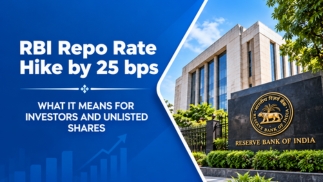
The question many investors are asking is simple: should they feel threatened, or see an opening? This blog explains the numbers, the reasons behind the move, the likely market impact, and why the unlisted share space deserves attention in a volatile environment.
What Is the Repo Rate and Why Does It Matter?
The repo rate is the rate at which the RBI lends short-term money to commercial banks. When the RBI raises it, banks' cost of funds goes up. They pass this on to customers through higher loan rates, and they also tend to offer better returns on deposits over time. In simple terms, a higher repo rate makes money more expensive and tightens liquidity in the system.
One basis point is 0.01%, so 25 bps equals 0.25%.
Repo Rate at a Glance: The Key Numbers
Parameter | Figure |
Repo rate before the hike | 5.25% |
Size of the hike | 25 bps (0.25%) |
Repo rate after the hike | 5.50% |
Last time the RBI raised the repo rate | February 2023 (to 6.50%) |
Cumulative rate cuts in 2025 | 125 bps (from 6.50% to 5.25%) |
Number of consecutive reviews with rates unchanged before this hike | 4 |
Policy stance at the August 2026 review | Neutral |
MPC meeting dates | 5 to 7 October 2026 |
This is the first repo rate increase in nearly four years, which is why it has drawn so much attention.
Why Did the RBI Raise the Repo Rate?
As per the post, the central bank's goal is to control inflation and protect the value of the currency, which in turn supports stable long-term growth. Several pressures were widely discussed by economists ahead of the decision:
Inflation: Retail inflation had moved above the RBI's 4% target.
Crude oil: Prices were reported above $100 per barrel, raising import costs and price pressure.
Weak rupee: The rupee was trading in the range of roughly ₹95 to ₹96 against the US dollar.
Global rates: The US Federal Reserve had recently raised rates by 25 bps.
Strong growth and credit demand: With growth resilient, the need for an accommodative stance had reduced.
Liquidity management: The RBI had been draining surplus cash through open market operations (OMO) bond sales worth ₹1 lakh crore in September 2026.
Factor | Reported Level / Trend |
Retail inflation | Above the 4% target |
Crude oil | Above $100 per barrel |
USD/INR | Around ₹95 to ₹96 |
US Federal Reserve | Recent 25 bps hike |
OMO bond sales (September 2026) | ₹1 lakh crore |
Note: These figures are based on pre-decision reports and may change. Please verify against the latest RBI and market data before publishing.
What a 25 bps Hike Means for Your Wallet
Loan EMIs: Borrowers whose loans are linked to the repo rate (external benchmark lending rate, or EBLR) will see EMIs rise within a quarter. On a ₹50 lakh home loan for 20 years at about 8.5%, each 25 bps increase adds roughly ₹800 to the monthly EMI.
Scenario (₹50 lakh, 20-year loan) | Interest Rate | Approx. Monthly EMI | Approx. Increase |
Before the hike | About 8.50% | About ₹43,391 | Not applicable |
After a 25 bps hike | About 8.75% | About ₹44,186 | About ₹795 |
After a further 25 bps hike (50 bps total) | About 9.00% | About ₹44,986 | About ₹1,600 over the original |
Fixed deposits: Deposit rates generally follow the repo rate. If more hikes are expected, locking a very long FD immediately may not be ideal, since a short deposit or a short wait could fetch a better rate.
Existing equity investors: Higher rates raise the discount rate used to value companies, which can pressure valuations of growth stocks in the short term.
What Is the Rate Outlook? Analyst Forecasts
The hike may not be a one-off. Several research houses expect more tightening, though views differ.
Source | Forecast |
SBI Research | 25 bps in October and another 25 bps in December, taking the repo rate to 5.75% |
Nomura | 25 bps hikes in both October and December |
Union Bank of India | 25 bps in October, plus one or two more hikes in FY27, taking the rate to 5.75% to 6% |
Bank of America Securities | Total tightening of 100 bps, with the repo rate reaching 6.25% by the first half of 2027 |
Some market participants | A shallow cycle of 25 to 50 bps in total |
These are forecasts, not RBI commitments. The actual path will depend on inflation, oil prices, the rupee and growth data.
How the Rate Hike Affects the Market
Short Term: Volatility and Caution
Higher rates reduce liquidity and make investors cautious. Many prefer to stay on the sidelines, and volatility is to be expected. Rate-sensitive sectors such as banks, real estate, auto and NBFCs often react first.
Long Term: Credibility Attracts Capital
Controlled inflation and a stable currency make for a credible economy, and credible economies attract global investors. A central bank that acts early to protect price stability builds confidence, which supports sustained growth over the long run.
Time Horizon | Likely Impact |
Short term | Reduced liquidity, cautious sentiment, higher volatility |
Medium term | Costlier credit, pressure on rate-sensitive sectors, better deposit returns |
Long term | Lower inflation, stable rupee, stronger investor confidence |
Why Volatility Can Work in Favour of Unlisted Shares
When markets are jittery, quality companies are often repriced on sentiment rather than fundamentals. The unlisted space can benefit from this in a few ways:
Reasonable entry valuations: Investors may get the chance to enter strong, growing businesses at more attractive valuations.
Early access before the IPO: Buying well before an IPO brings wider attention lets investors participate in the growth story early.
Less day-to-day noise: Unlisted holdings are not tracked tick by tick, which encourages a long-term, disciplined approach.
Diversification: They add a different asset class beyond listed equity, debt and gold.
Finding such gems before they go public is a major advantage of buying unlisted shares. The wisdom of entering during a volatile phase, armed with discipline and diligence, tends to stand the test of time.
Listed vs Unlisted Shares: A Quick Comparison
Feature | Listed Shares | Unlisted Shares |
Trading venue | Stock exchanges (NSE, BSE) | Private or over-the-counter transactions |
Liquidity | High | Lower, with a lock-in until listing or exit |
Price discovery | Real time | Negotiated, less transparent |
Information availability | Mandatory disclosures | Limited, so due diligence is critical |
Entry stage | After listing | Often before the IPO |
Risk profile | Market risk | Market risk plus illiquidity risk |
Risks You Should Not Ignore
Unlisted shares carry real risks, and responsible investing means understanding them:
Illiquidity: You may not be able to sell quickly, and the exit may depend on an IPO or a buyer.
Valuation uncertainty: Prices are not publicly displayed, so careful checking is necessary.
IPO delays: Listing timelines can shift with market conditions, and rising rates may delay some IPOs.
Limited disclosures: Always verify financials, shareholding and legal status.
A practical checklist: review the company's financials, check the promoter and investor base, confirm the share transfer process and demat delivery, compare valuation with listed peers, and invest only what you can leave untouched for a long period.
Our Perspective at SN Capital
Rate hikes are only the beginning of the story. Businesses that stand the test of time remain relevant and rewarding across interest rate cycles. For long-term investors, the focus should be on quality, discipline and patience rather than on reacting to every headline.
Want to know more about buying unlisted shares that could create wealth in the long term? Message us or visit our page.
Frequently Asked Questions (FAQs)
1. What is the current repo rate after the RBI hike?
After the 25 bps hike, the repo rate moves from 5.25% to 5.50%. This is the first increase since February 2023, when the rate was raised to 6.50%.
2. How does a repo rate hike affect my home loan EMI?
If your loan is linked to the repo rate (EBLR), your rate and EMI rise within a quarter. On a ₹50 lakh, 20-year loan at about 8.5%, every 25 bps increase adds roughly ₹800 per month. Fixed-rate loans are not affected until they are renewed or refinanced.
3. Will the stock market fall because of the rate hike?
Not necessarily. Short-term volatility is common because higher rates reduce liquidity and make investors cautious. If a hike has been widely expected, much of it may already be priced in. Over the long term, markets tend to follow earnings growth and economic stability.
4. Why are unlisted shares considered during a volatile market?
When sentiment is weak, even quality companies can be repriced for reasons unrelated to their fundamentals. In the unlisted space this can mean entering strong businesses at more reasonable valuations before an IPO. However, unlisted shares carry illiquidity risk, so thorough diligence and a long investment horizon are essential.
5. Are fixed deposits a better option after a rate hike?
Deposit rates generally move in line with the repo rate, so they may become more attractive over time. Since further hikes are possible, some savers prefer shorter deposits or staggered investments (an FD ladder) rather than locking everything into a long tenure at once. Your choice should depend on your goals, risk appetite and time horizon.
Disclaimer: Investments in unlisted shares involve risks including illiquidity. This is not investment advice. Any investments made are at one's own risk. Please consult an investment advisor before making any investment decisions.